
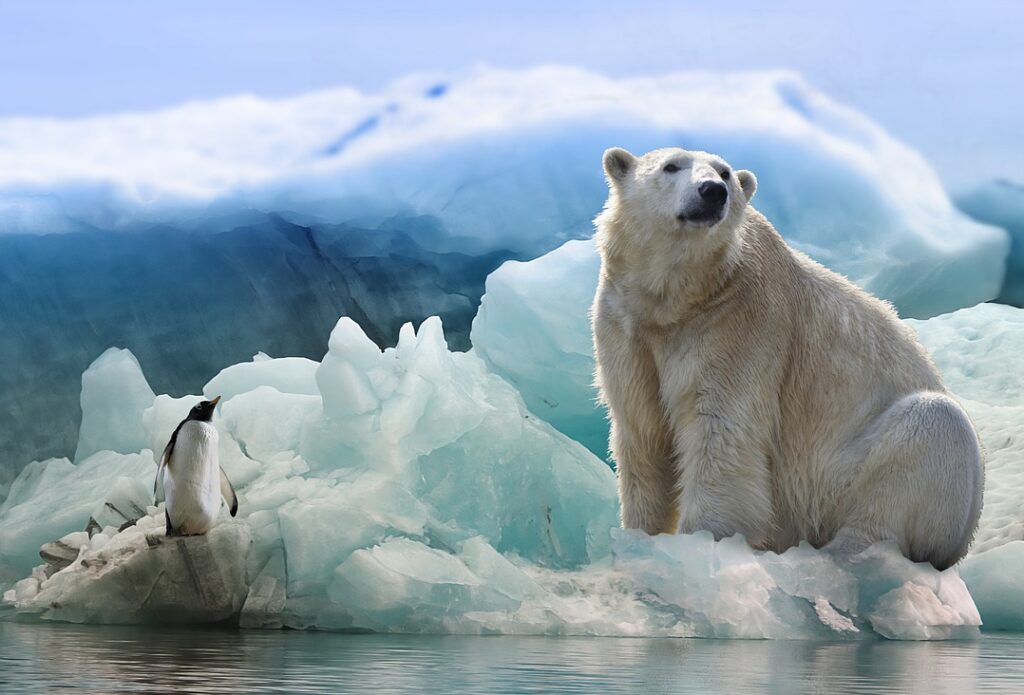
In the future, rising of the sea level is predicted due to the recession of glaciers over the land. Melting and recession of Antarctica and Greenland will cause oceans to expand at first and then sea level to rise in the next level. Sea level rose nearly 17 meters in the 20th century. An additional increase of 18 to 59 meters is expected till the end of this century. All these numbers are based on scientific measurements and estimations are based on the greenhouse gas emission scenarios conducted by the scientists best in their field. As the sea level rise, coastal groundwater sources are threatened more and more with the contamination of salt water. This sea level increase is especially important for the islands and the lands located below the sea level.
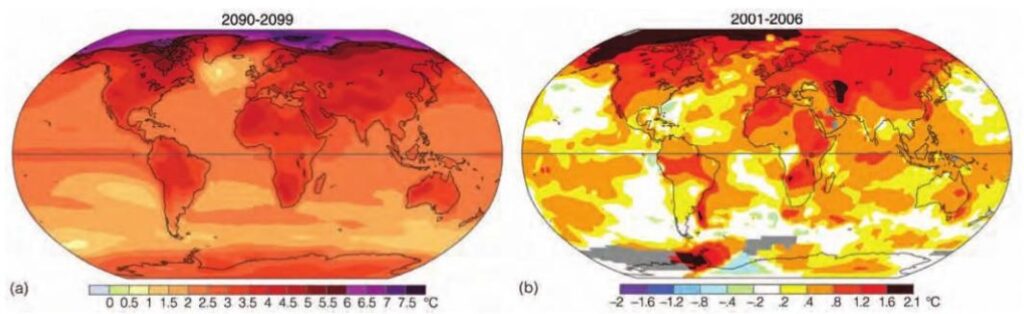
Figure 1: (a) Projected surface air temperature changes averaged for the decade 2090-2099 compared to the average surface temperature for the period 1980-1999. (b) The average change in surface air temperature for the period 2001-2006 compared to the average for the years 1951-1980. Image courtesy; C.D.Ahrens, Extreme Weather and Climate.
According to the climate models at the end of year 2099, +3 to +7.5°C temperature increase is expected in polar regions compared to the surface temperatures in year 1980. Which shows us the severity of the global warming problem all around the world.
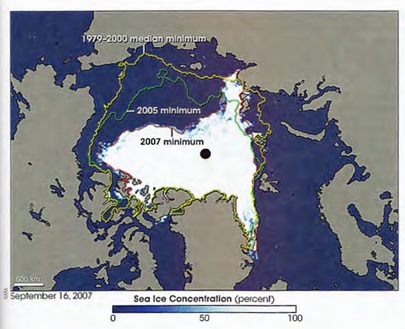
Figure 2: The extent of arctic sea ice on September 16, 2007 when the ice cover was at its record minimum. The green line indicates the previous minimum from 2005, whereas the yellow line indicates the median minimum sea ice extent over the period between 1979 and 2000.
According to the NASA satellite images arctic sea ice coverage decrease with the years. Compared to the 1979-2000 ice cover, in 2007 it is almost the half. Which also indicates how high the melting rate is.
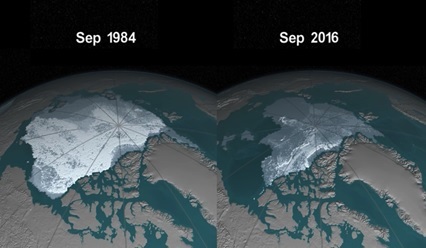
Figure 3. NASA image of disappearing Arctic polar ice cap over the years 1984 to 2016. Image credit: NOAA
Another picture obtained from NASA also shows us the artic cap change over the years between September 1984 to September 2016. Compared to the previous picture (Fig 2) we can say that melting rate is decreased since the polar area is not completely disappeared. However, it is very early to conclude that the danger is over. All of the climate models strongly indicate that, there will be an increase in the melting of polar regions in the next years.

Figure 4. Seasonal arctic sea ice extent change with years 1979 to 2010. Image credit: US National Snow and Ice Data Center.
We must not forget that in a year due to seasonal temperature changes, there is an annual cycle with ice extent peaking in March and reaching a minimum in September. However normal this is, artic sea extent decreased noticeably between 1979 to 2010. In 2007, the sea extent in September was just over 4 million km2, the lowest in recorded history.
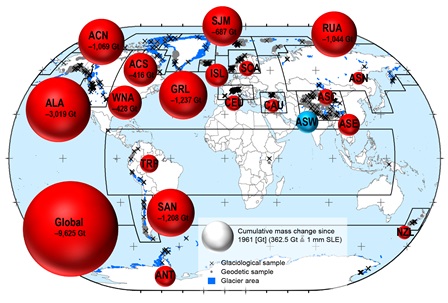
Figure 5. Regional share of glaciers in sea level rise from 1961 to 2016., Image credit: Zemp et al. 2019, Nature.
According to the article published in Nature (the most prestigious science journal in the world) by Zemp et al., with more than 3,000 Gt, glaciers in Alaska (ALA) contributed the most to the increase in sea levels. Overall global glacier mass is around 9,600 Gt (1 Gt= 1 billion tons).
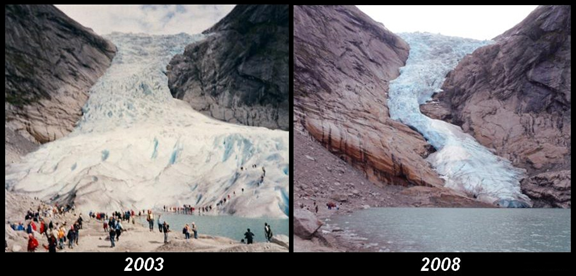
Figure 6. There are so many conspicuous glaciers in the world. One of them is the change of Briksdalbreen arm of the Jostedal Glacier in Norway from 2003 to 2008. Just in 5 years there is a big difference in glacier mass.
There are many glacier-fed rivers all around the world. Melting of the glaciers potentially means the decrease in the supply of meltwater to those rivers. This water supply is especially important for Tibet, Pakistan, India and Bangladesh. As an example Gangotri glacier which provides 70 percent of the Gange river water has a shrinking rate of 22 meters per year. This rate is twice as fast as 20 years ago which puts the major water source of this holy water in a great danger.
Albedo also plays a great role in all this glaciers melting’s and climate change. Glaciers have a higher reflectivity than soil and if the glacier area decreases, land will absorb more solar radiation which would increase overall global temperatures and would cause a positive feedback effect to cause an increase in the melting of the glaciers. Because of this problem it is important to slow down the melting before it is too late.
Land use also have the same albedo effect that we mentioned before. Overgrazing, overcultivation, poor irrigation practices and deforestation causes a decrease in the green leaves covered areas on the land which has low albedo. That bad land practiced causes evaporation and evapotranspiration decrease as well as an increase in absorbed solar radiation in the soil that would eventually cause desertification in the long run. Currently billions of hectares of the cropland is threatened by desertification.
Past 30 years there has been a continued decrease in global glacier ice mass. Around 340 billion ton of ice melted per year away which around 1 mm lea level increase in yearly basis. Researches suggest that at the end of this century most of the glaciers would disappear for good while sea level notably increases.
As we mentioned before melting glaciers would either cause glacier-fed rivers to deplete or salt water pollution in surface waters due to an increase in sea levels. In order to face any water problems in the future we have to do anything in our power to decrease the rate of the global climate change. In the next blog post we will be mentioning the meteorological causes of the floods and their occurance in the UK. Stand by for our next post and stay healthy 😊
Resources:
- Meteorology Today: An Introduction to Weather, Climate, and The Environment, First Canadian Edition by C. Donald Ahrens, Peter L. Jackson, Christine E. J. Jackson
- Deutsche Welle News, Ganges under threat from climate change, Author: Jasvinder Sehgal, 24.10.2017
- Fox2Now News, NASA releases time-lapse of the disappearing Arctic polar ice cap, Author: CNN Wires, Staff; Posted on: 26.02.2018
