
Most research papers focus on the relation of COVID-19 and COVID alike viruses such as SARS, transmissible gastroenteritis virus (TGEV) and mouse hepatitis virus (MHV). In this post we will summarize the results of some research papers and give you a perspective of the relation of ambient temperature, relative humidity and spread rate of Covid-19.
SCIENTIFIC INFORMATION
In a scientific article published in the Public Health Microbiology Journal, effects of air temperature and Relative Humidity on Coronavirus Survival on Surfaces are examined. This research is conducted using two different corovirus type viruses; transmissible gastroenteritis virus (TGEV) and mouse hepatitis virus (MHV). According to the researchers Casanova, Jeon, Rutala, Weber and Sobsey, inactivation was more rapid at 20°C than at 4°C at all humidity levels; the viruses persisted for 5 to 28 days, and the slowest inactivation occurred at low RH. Both viruses were inactivated more rapidly at 40°C than at 20°C. There was also evidence of an interaction between ambient temperature and relative humidity. The results show that coronavirus may survive for days on surfaces at ambient temperatures and relative humidities typical of indoor environments. [1]
According to an article with the name “The Effects of Temperature and Relative Humidity on the Viability of the SARS Coronavirus” prepared by the researchers K. H. Chan, J. S. Malik Peiris,S. Y. Lam, L. L. M. Poon,K. Y. Yuen and W. H. Seto, viability of SARS coronavirus was rapidly lost at higher temperatures and higher relative humidity. It may also explain why some Asian countries in tropical area with high temperature and high relative humidity environment did not have major community outbreaks of SARS. [2]
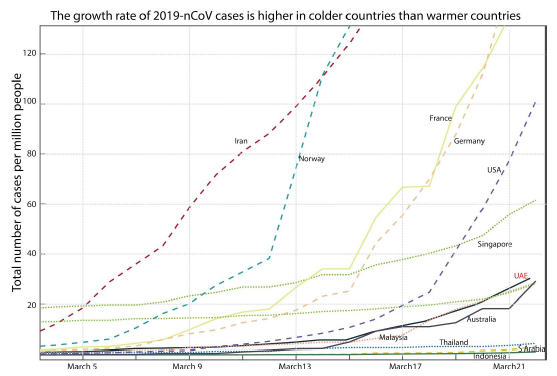
According to another scientific article named “Will coronavirus pandemic diminish by summer?” by the MIT Researchers Qasim Bukhari and Yusuf Jameel, the relation between the number of 2019-nCoV cases and temperature and absolute humidity observed is quite strong. However the underlying reasons of their relationship is still not clear. If the temperature dependency of 2019-nCoV is similar to that of SARS-Cov, then it will loose its ability to survive in higher temperatures. That will be due to the breakdown of their lipid layer at higher temperatures. The higher number of tests and global connectivity of the northern-cooler countries may explain the difference in number of confirmed 2019-nCoV cases between cooler and warmer-humid regions. The growth trajectory in the next one month in these relatively warm and humid countries would be critical in understanding the dependency of 2019-nCoV cases on temperature and humidity. [3]
Applied and Environmental Microbiology Apr 2010, 76 (9) 2712-2717; DOI: 10.1128/AEM.02291-09
FOR UK
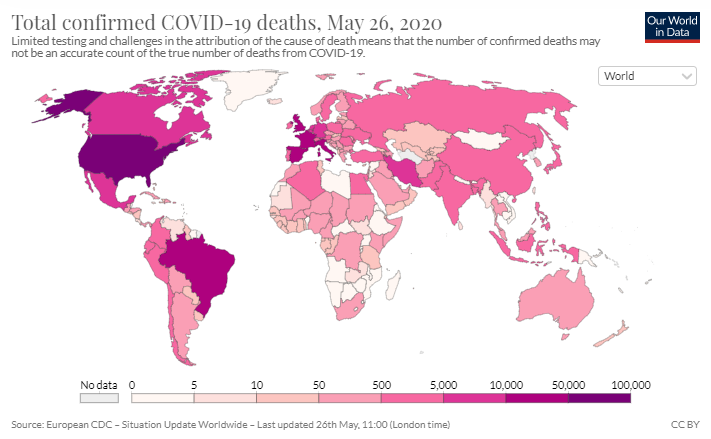
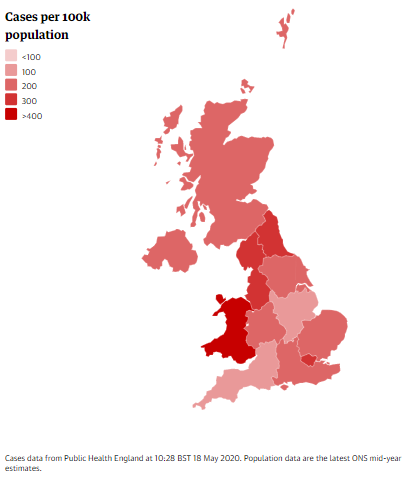
According to the number of the cases recorded in UK, spread rate of COVID-19 in the southern UK is much lower than the northern region due to the temperature and relative humidity. Scientists expect that with upcoming curcimstances of warm season approaching, COVID-19 spread rate will decrase significantly.
Sources:
[1] Casanova L.M., Jeon S., Rutala W.A., Weber D.J. & Sobsey M.D. (2010). Effects of Air Temperature and Relative Humidity on Coronavirus Survival on Surfaces. Applied and Environmental Microbiology, 76 (9) 2712-2717; DOI: 10.1128/AEM.02291-09
[2] Chan, K.H., Peiris, J.S.M., Lam, S.Y., Poon, L.L.M., Yuen, K.Y., Seto, W.H. (2011). The Effects of Temperature and Relative Humidity on the Viability of the SARS Coronavirus. Advances in Virology, DOI: 10.1155/2011/734690
[3] Bukhari, Q. & Jameel, Y. (2020). Will Coronavirus Pandemic Diminish by Summer? Available at SSRN: https://ssrn.com/abstract=3556998 or http://dx.doi.org/10.2139/ssrn.3556998
